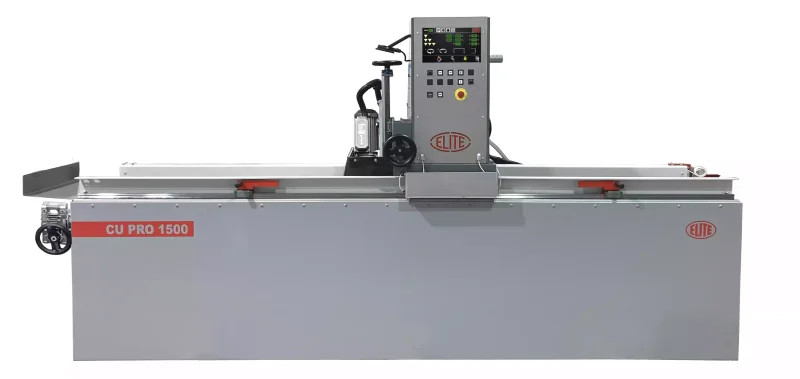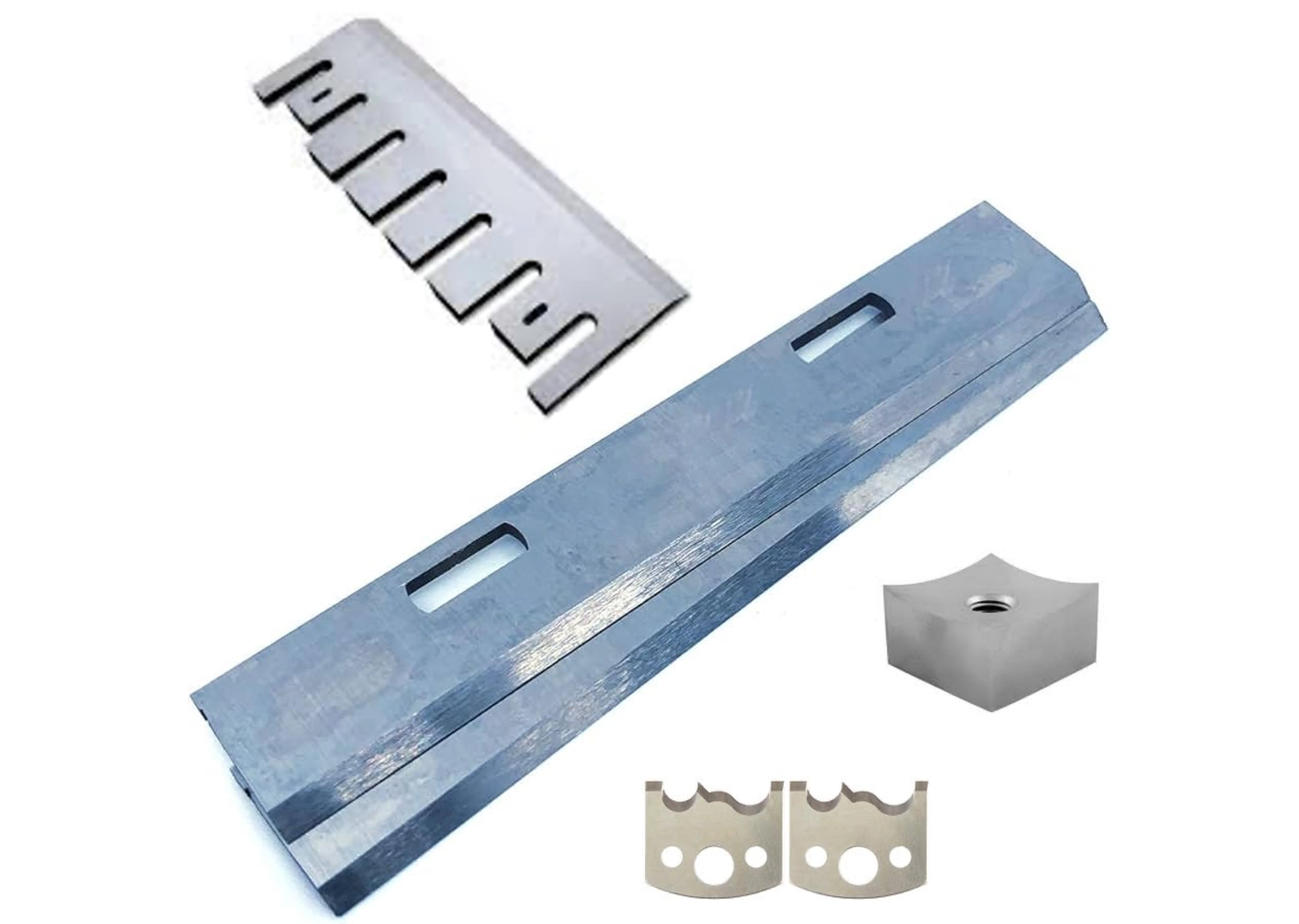
In the daily work with cutting tools, one of the most common challenges is achieving a precise, uniform, and efficient sharpening. Many professionals share their questions with us about how to properly sharpen their straight blades, especially when working with different materials such as high-speed steel (HSS) or tungsten carbide.
The key lies not only in the technique but also in having the right system. At ELITE, we have developed solutions that simplify this process and guarantee professional results. Here we summarize the key points for achieving a perfect sharpening of straight blades.

Identify the blade material: Each material requires a specific type of abrasive.
High-speed steel (HSS)
For high-speed steel or HSS, we will always use a CBN or borazon grinding wheel, as it is the one best suited to this material. We will need to select the abrasive grit, its concentration, and other parameters based on the type of HSS.
Many HSS blades are planer-type; if so, they must be mounted on an accessory called a "ladder." The ladder allows you to hold up to 4 blades at once as standard (ladders for a larger number of blades are available as an option). You must choose the correct ladder to ensure a perfect fit without play.
It is essential to define:
- Blade cutting angle
- Blade thickness
This will determine the type of ladder to use.
Steel of Different Hardness Grades
In the case of hardened or unhardened steel, we will opt for corundum or resin. Resin-bonded grinding wheels are more versatile, but also have lower hardness. Corundum, on the other hand, is harder, but we must carefully choose the most suitable grit, porosity, and bonding agent.
If the steel has a high temper or hardness, we prefer to use a segmented grinding wheel because it offers better abrasion capacity, better cooling, and is more economical than a corundum cup wheel. This is because the segment has less material than a cup wheel, but provides the same amount of usable material for sharpening.
Segmented Grinding Wheel

Generally, it's the steel that generates the most uncertainty regarding the type of abrasive to use. A good option for sharpening workshops is to equip your grinder with a wheel speed controller. By regulating the wheel's rotation speed, you change the abrasive's behavior, making it harder and therefore more suitable for softer materials, or harder, which is better for harder materials. This way, we can sharpen different types of blades with the same corundum grinding wheel.
Tungsten Carbide (Hard Metal)
For hard metals, we always use a diamond grinding wheel. We have no other option. Special care must be taken when securing these blades, as they cannot be magnetized with the machine's built-in magnetic plate. For this, we use a magnetic plate with extreme polarity, which are specifically designed for hard metals.
At ELITE, we design our machines and accessories with these details in mind: precision, ease of use, and professional results. If you're looking to optimize your sharpening process, our solutions are ready to take your production to the next level.
Don't hesitate to contact us for more information at [email protected]